Location
Dates
Surface
Developer
Builder
Photograph
c. Roca i Batlle, Sarrià-Sant Gervasi
2017-2020
272 m²
Comunitat de propietaris
Rehabilitation of the main facade of a modern building designed by Jordi Adroer Iglesias at the top of the Putxet district. The direction of the work was carried out in 1971 by the quantity surveyor Carlos Rovira Leboso and the builder was Miquel Muntané.
A building aligned to a steeply sloping street. The façade is an interesting composition of modern architecture that achieves a difficult balance between the symmetry of the upper floors with two dwellings per floor, with balconies overhanging both sides of the center of the façade and the asymmetry of the first floor, with the pedestrian access, the entrance to the parking lot and a dwelling.
Two parallel strips of artificial stone underline the edges of the slabs and the crowning of the facade. On each floor, an aluminium louvered shutter between wooden mullions protects the openings. Each closing module combines an opaque white wooden sill and an opening leaf. Sun protection is provided by the white aluminium slat roller shutter, which protects the entire enclosure from ground to ceiling. The closing modules that do not correspond to openings are covered with the same aluminium slats as if the blind were fully lowered.
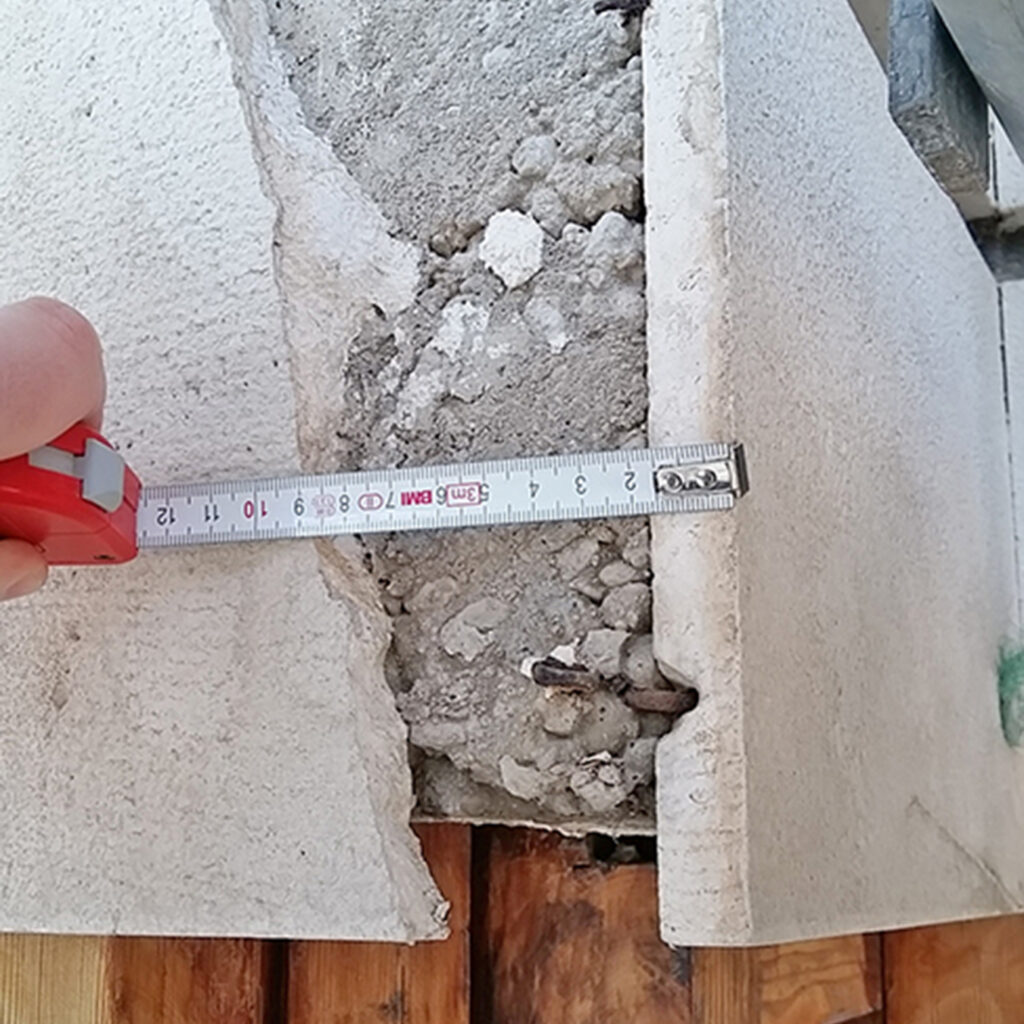
The reason for the intervention was the fall of fragments of the artificial stone slabs on the street. After initial surveys, it became evident that the inner reinforcement of the artificial stone slabs was in an advanced state of carbonation. Despite the fact that the slabs had been secured with new mechanical fasteners in a previous rehabilitation, the carbonation had continued and was now fragmenting the slabs and causing them to fall in pieces.
Once the main pathology was identified, it was decided to replace all the artificial stone pieces with new ones. We took the opportunity to clean and clean all the wood of the old varnish and protect it again. The aluminium blinds also had to be replaced, since the original lacquer had aged and had peeled off over a large part of the surface.
The maximum effort was made to recover the original values of the facade, introducing the minimum changes and trying to find industrialists who could provide the new artificial stone, the new shutters, as well as the tiles of the balconies, so that fifty years later, they could replace the original ones with the minimum possible alterations with respect to the original state.